MVP for Wellness Apps: What to Build First (and What to Skip)

Mykyta Shevchenko
CEO & Co-founder
Launching a wellness app today is less about adding features and more about making the right decisions early. The difference between products that gain traction and those that quietly disappear often comes down to how the MVP is scoped. In wellness, users are not exploring your product out of curiosity alone. They come with a specific need—reduce stress, improve sleep, build healthier habits—and they quickly decide whether your app is worth their time. If the first experience feels unclear, overloaded, or irrelevant, they simply don’t come back. That’s why a well-structured MVP wellness app is not just a technical milestone. It’s a strategic tool that helps you validate your idea, reduce unnecessary costs, and focus on real user outcomes instead of assumptions. This article explores how to define the right scope, choose effective app MVP features, and apply lean product development in a way that works specifically for wellness products.
Why Wellness MVPs Require a Different Approach
Wellness applications differ from most digital products in one important way: their value is not defined by access or convenience, but by whether the user experiences real progress. Functionality alone is not enough. People come to these products with an expectation of change—emotional, physical, or behavioral—and even small signs of improvement shape whether they continue using the app.
This shifts the logic of building an MVP. In many industries, a simplified version of a product can still be useful because it provides access to a service or saves time. In wellness, however, a product that does not lead to a tangible result quickly loses its meaning for the user. If there is no visible progress, engagement drops regardless of how well the interface is designed.
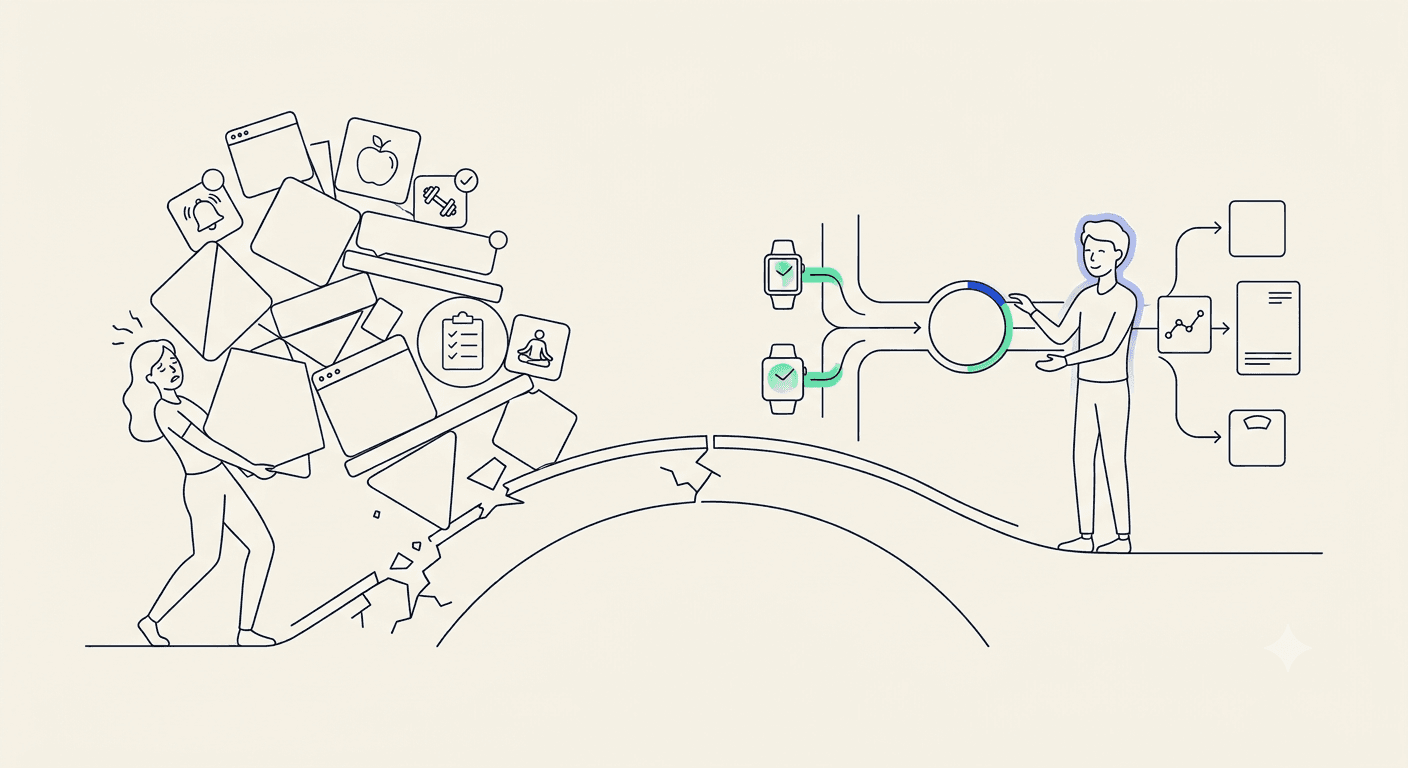
Adding more features does not solve this problem. On the contrary, an excess of options often creates friction: onboarding becomes more complicated, decision-making slows down, and the core purpose of the product becomes less clear. Instead of increasing value, complexity dilutes it.
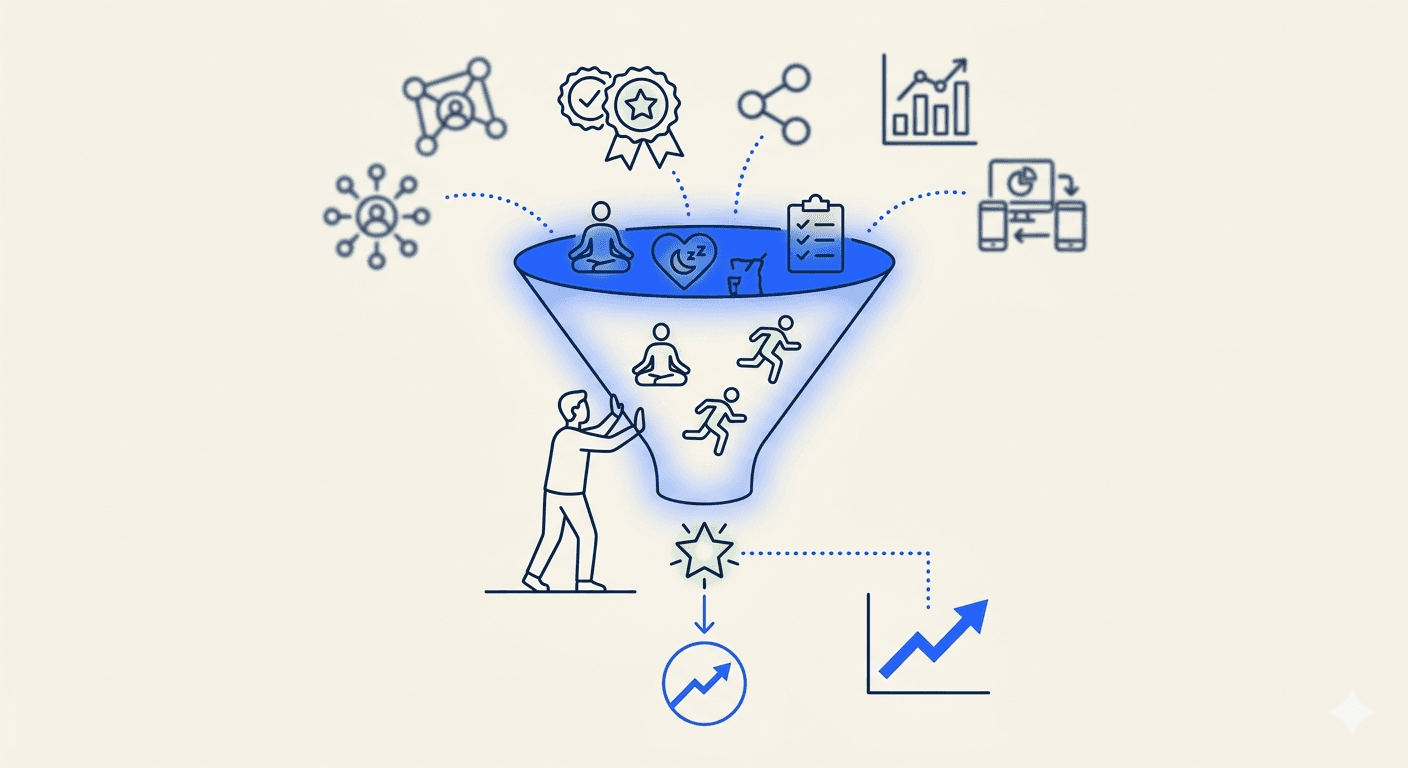
Effective wellness MVPs are intentionally focused. They are built around a limited number of actions and guide the user toward completing them with minimal distraction. This clarity helps reduce cognitive load and increases the likelihood that the user will reach a first meaningful result.
For this reason, the common definition of an MVP as “the smallest version of a product” is not particularly useful in this context. A more accurate interpretation is the smallest version of a product that can deliver a measurable outcome within a short period of time. The emphasis shifts from reducing scope to ensuring impact.
Such outcomes need to be specific and observable. This could mean completing a series of guided sessions, consistently tracking a habit over several days, or identifying a recurring behavioral pattern. The exact form may vary, but the principle remains the same: the user should be able to notice a change.
If this initial experience of progress is missing, improvements in design or additional functionality will not compensate for it. This is a common issue in product teams that prioritize building systems over shaping user experiences.
A more effective approach begins with defining the outcome. Instead of framing a product as “a meditation app,” it is more practical to describe what the user will achieve—for example, completing five short sessions during the first week. This formulation creates a clear benchmark and directly informs product decisions.
Once the expected result is defined, feature selection becomes more straightforward. The focus shifts from what might be useful to what is essential. Elements that do not directly contribute to the desired outcome can be postponed without weakening the product.
This outcome-oriented approach is particularly relevant for wellness products, where user attention is limited and expectations are closely tied to personal progress.
How to Identify the Right MVP Features
When teams start defining app MVP features, there is a natural inclination to include more than necessary. It often feels like a safer strategy: more functionality seems to imply more value. In practice, this assumption rarely holds.
If we consider a basic meditation app, its core function is straightforward—guiding the user through sessions. From this perspective, the MVP only requires a few essential components: a simple introduction, a limited set of relevant sessions, the ability to play them, and a minimal way to track progress.
Everything beyond this—such as social sharing, complex recommendation systems, or detailed analytics—does not directly contribute to the initial user outcome. These features may become useful later, but at the MVP stage they do not help answer the main question: does the product create value for the user?
What matters is immediacy and clarity. The user should quickly understand what to do and feel a sense of completion after the first interaction.
Designing an Onboarding That Leads to Action
In wellness applications, onboarding should not be treated as a preliminary setup phase. It is the first part of the product experience and should smoothly transition into action.
When users are presented with too many questions or decisions at the start, hesitation increases. This is particularly relevant in wellness contexts, where users may already feel uncertain or cognitively overloaded.
A more effective approach is to reduce onboarding to its functional minimum. Instead of gathering extensive input, the focus should be on directing the user toward their first meaningful action. For example, one well-placed question about the user’s goal, followed by an immediate suggestion, can significantly lower the barrier to entry.
The shorter the path to the first interaction with the core feature, the higher the likelihood of engagement.
Building the Core Experience Without Distractions
At the center of any MVP is the core experience, and it should be immediately clear to the user.
Navigation and structure should not require exploration or learning. The next step—whether it is starting a session, logging an activity, or following a routine—needs to be obvious without additional effort.
This simplicity is not a limitation but a design advantage. When users do not have to decide what to do next, they are more likely to continue interacting with the product.
It is also important to avoid over-enriching the experience at this stage. A small number of well-designed options is more effective than a broad but unfocused set of features. Early-stage products benefit from precision, not volume.
Making Progress Visible Without Overcomplicating It
Feedback plays a central role in wellness applications. Users need to understand that their actions lead to results.
However, this does not require complex visualizations or detailed analytics. In early stages, excessive data can reduce clarity rather than improve it.
Simple indicators—such as completed sessions, short streaks, or small milestones—are usually sufficient. They reinforce behavior and provide a sense of continuity without overwhelming the user.
At the MVP stage, the goal is not deep analysis, but consistent engagement.
Data Collection: Less Is More
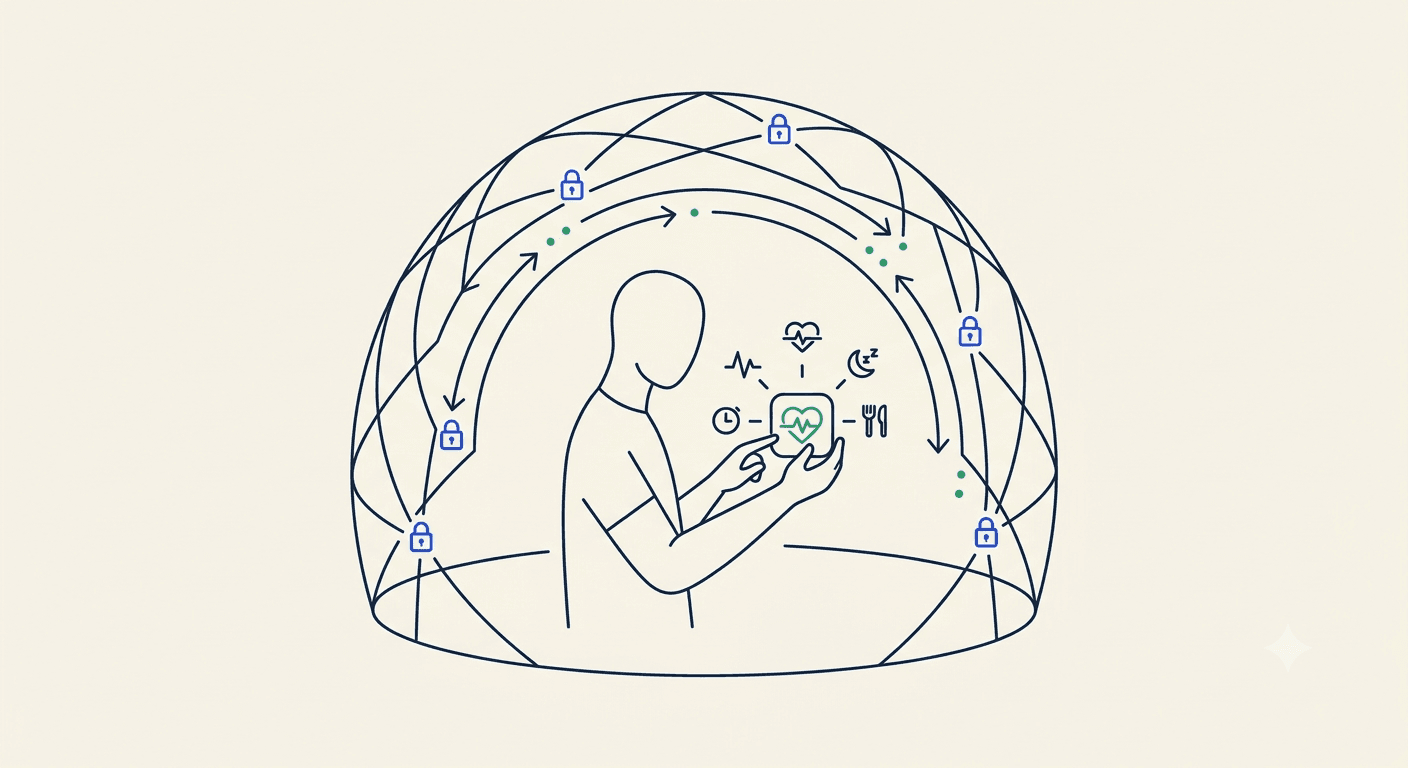
Because wellness products often involve personal data, trust becomes a key factor in user adoption.
Requesting too much information at the beginning can create resistance. Users are less likely to share personal details before they understand what they gain in return.
A gradual approach is more effective. Start with minimal data collection and expand only when it is clearly justified by user value. As users begin to see benefits, their willingness to share additional information increases naturally.
This approach aligns with lean development principles, where product decisions are based on observed behavior rather than assumptions.
Features That Can Wait
It is common to think ahead and consider features that could strengthen the product in the future. However, many of these additions introduce unnecessary complexity at the MVP stage.
Advanced personalization is a typical example. While it can improve user experience in mature products, it depends on large datasets and ongoing optimization. Early versions can rely on simple, rule-based logic without losing effectiveness.
Social functionality presents similar challenges. Building and maintaining user interaction layers requires moderation, privacy management, and continuous engagement efforts. Unless social interaction is central to the product concept, it can easily divert focus from the core experience.
Gamification is also often overestimated. Elements like points or badges do not create engagement on their own. If the underlying experience lacks value, these additions will not compensate for it.
Integrations with wearables or external platforms can also be postponed. Although they may enhance the product later, they significantly increase development complexity and are rarely necessary for initial validation.
Applying Lean Product Development in a Practical Way
Lean product development is often described as a concept, but its effectiveness depends entirely on how it is implemented in practice. At its core, it is a continuous cycle: a team releases a focused version of a product, observes how users interact with it, and adjusts based on real behavior rather than assumptions.
In the context of wellness applications, this process should be centered on user actions, not surface-level indicators. Metrics such as downloads or registrations provide limited insight into actual value. A more meaningful question is whether users complete the core action and return to it over time.
For instance, if users start sessions but rarely finish them, the issue is likely within the experience itself rather than acquisition. If they complete sessions but do not return, this may indicate gaps in habit formation or insufficient reinforcement. Observing these patterns allows teams to make targeted improvements instead of broad, unfocused changes.
Where Most Wellness MVPs Go Wrong
Even experienced teams encounter difficulties at the MVP stage when attention shifts away from user outcomes.
A frequent issue is attempting to solve multiple problems within a single product. Wellness is a broad domain, and combining several directions often reduces clarity and weakens the overall experience.
Another common challenge is overdesign. Excessive time spent refining visual details can delay product release without improving usability. At the MVP stage, clarity and functional coherence are more important than visual polish.
Behavior design is also often underestimated. Without understanding how users build habits or what motivates them to return, even well-developed features may remain unused.
Finally, excessive data collection can introduce friction. Users are unlikely to share personal information until they clearly understand the product’s value and trust how their data will be used.
Validating Your MVP Without Wasting Time
Once an MVP is launched, validation should focus on generating actionable insights rather than large volumes of data.
Releasing the product to a broad audience may seem efficient, but it often produces fragmented and inconclusive results. A more reliable approach is to work with a clearly defined user group that has a specific need. This makes it easier to evaluate how the product fits into real routines.
Equally important is combining quantitative metrics with qualitative feedback. Usage data can highlight patterns, but direct interaction with users explains the reasons behind those patterns.
Careful observation of real user behavior often reveals issues and opportunities that are not visible through analytics alone.
Scaling Beyond the MVP Stage
When an MVP consistently delivers the intended outcome, the product can begin to expand.
At this stage, development priorities should be guided by actual usage. Features that users engage with regularly can be enhanced, while those that receive little attention may not require further investment.
Personalization can be introduced incrementally. Initial versions may rely on simple logic, with more advanced systems added as sufficient data becomes available.
Additional integrations and features should be implemented cautiously, ensuring they support the core experience rather than complicate it.
Building a Foundation That Can Grow
Although an MVP is intentionally minimal, it should still be structurally reliable.
A well-considered technical foundation allows the product to scale without significant rework. This is particularly important in wellness applications, where stability and data security directly influence user trust.
Planning for growth does not require overengineering, but it does involve making deliberate architectural decisions that simplify future development.
Conclusion
Developing a wellness MVP is not about reducing effort, but about prioritizing correctly.
When a product is built around a clearly defined outcome, supported by focused MVP features, and iterated through lean product development, it becomes easier to validate and improve.
Rather than attempting to address every possible need from the beginning, the objective is to deliver a simple, coherent experience that provides immediate value and can evolve based on real user behavior.
Dive into our diverse articles – from wellness app design and AI personalization to software development best practices, operational workflows, and strategic guidance.



Load More