
How Much Does It Cost to Build a Wellness App? (Real Breakdown)

Mykyta Shevchenko
CEO & Co-founder
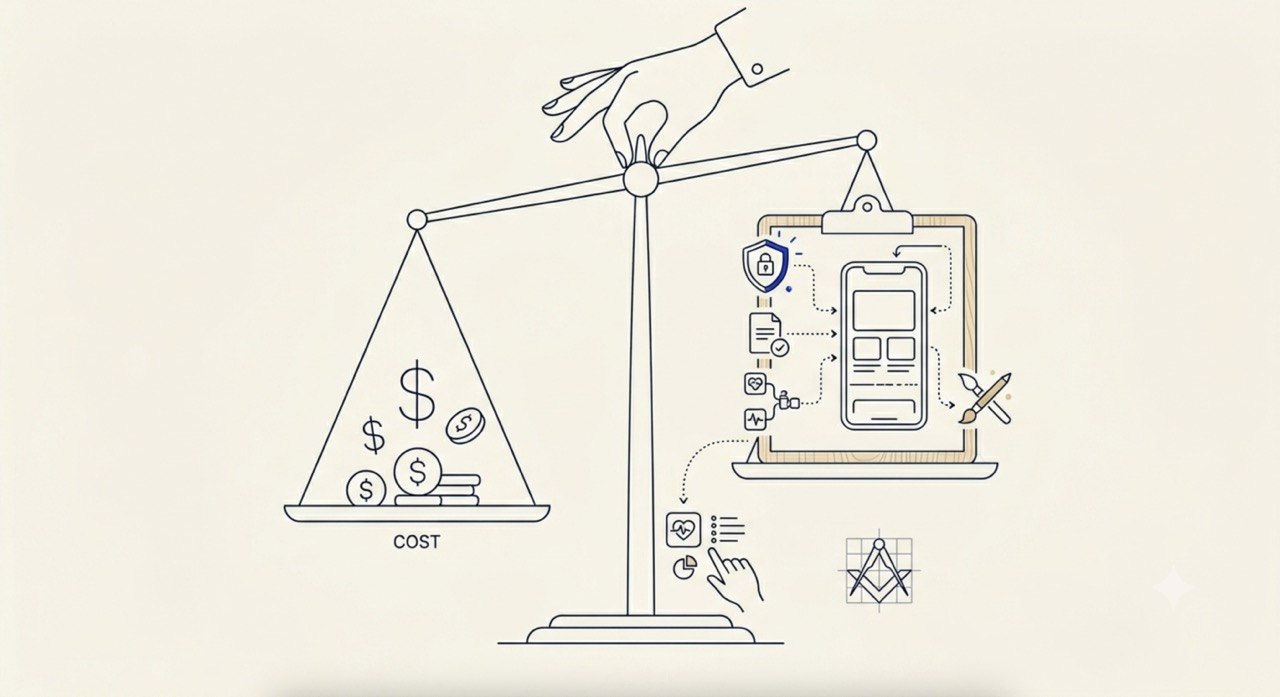
When calculating the financial blueprint for a digital health product, standard software development estimates fall short. Building a wellness app introduces specific cost centers: secure architecture, regulatory compliance, data processing for biometric inputs, and the product design required to drive sustained habit formation. For HealthTech marketers and product marketers, understanding app development pricing is about managing the relationship between initial feature scope, development infrastructure, and long-term scaling costs.
1. Cost Overview by Product Complexity
The scope of a digital wellness product dictates its initial investment. The total capital required changes significantly depending on feature depth and architectural complexity.
For a Mental Health and Meditation app utilizing mood logs, audio streaming, structured journaling, and basic therapist matching, an initial MVP launch requires between $40,000 and $70,000. Scaling that platform to include automated recommendations and deep content libraries brings the full-scale cost to between $70,000 and $140,000.
Fitness and Activity Tracking apps require wearable data synchronization, custom workout builders, and video libraries. These products cost around $45,000 to $65,000 for an MVP, with full-scale deployment ranging from $80,000 to $160,000 due to data processing demands.
Nutrition and Diet Management apps focus on calorie engines, barcode scanning, and custom meal generation. A functional MVP costs between $35,000 and $60,000, while a comprehensive platform with large ingredient databases requires a budget between $60,000 and $120,000.
Telehealth and Remote Coaching platforms demand the highest investment due to encrypted video consulting, provider scheduling, medical billing, and secure chat features. Building an MVP for this segment ranges from $60,000 to $90,000, while an enterprise-grade, full-scale deployment can start at $120,000 and surpass $280,000.
2. The Minimum Viable Product Blueprint
Launching a wellness app MVP cost typically ranges from $30,000 to $80,000. This budget covers the engineering needed to validate core value propositions with a target audience while establishing a foundation for future development iterations.
Core Components of a Regulated MVP
Secure Authentication & User Management: Frameworks built to handle user profiles, password hashing, and access roles securely.
Primary Utility Engine: The core feature driving user acquisition, such as an activity tracker, a content streaming service, or a daily log.
Basic Data Architecture: Secure cloud storage capable of handling incoming user inputs and biometric logs without data leaks.
Telemetry & Analytics: Integration of instrumentation libraries to measure product interaction metrics, engagement cycles, and drop-off points.
Allocating funds to these baseline mechanics ensures that the product functions reliably during early validation phases.
3. Core Drivers of Health App Development Cost
Several technical decisions impact overall health app development cost. Evaluating these factors early helps prevent mid-project budget adjustments and uncovers opportunities to streamline resource allocation.
Budget Allocation Breakdowns
When analyzing typical wellness development budgets, engineering and backend infrastructure consume the largest portion, usually accounting for 40% to 55% of total capital. UI/UX design requires 15% to 20% to ensure interface accessibility. Quality assurance, testing, and regulatory compliance demand 10% to 15%, while deployment, cloud operations, and store submission fill the final 5% to 10% of the financial allocation.
Engineering and Backend Infrastructure
Backend infrastructure handles data processing, synchronization across multiple devices, and business logic execution. A product relying on basic local storage requires less engineering effort than a system using complex real-time server synchronizations and server-side data processing.
Cross-Platform vs. Native Engineering
Cross-Platform Frameworks (Flutter, React Native): Single-codebase approaches lower upfront costs by roughly 30% to 40% compared to native builds. This method works well for content-heavy applications, standard monitoring dashboards, and products that need to hit both iOS and Android simultaneously on a tighter budget.
Native Development (Swift & Kotlin): Native engineering requires separate codebases, increasing engineering hours. This approach is necessary for products utilizing deep hardware access, real-time background processing, or complex Bluetooth wearable connections.
UI/UX Design and Behavioral Mechanics
Wellness applications require specialized product design focused on user retention and habit formation. Creating interface elements that encourage daily use, clear data visualizations, and accessible navigational layouts adds design time but helps reduce user churn over time.
Quality Assurance and Device Matrix Verification
Testing across the digital health landscape requires verifying app performance across varying operating system versions and physical screen dimensions. Inconsistent synchronization with system-level frameworks, like Apple HealthKit or Google Connect, can degrade the user experience if left unaddressed.
4. Hardware Integrations and External Data Sync
Connecting an application to hardware ecosystems increases engineering scope, affecting overall app development pricing.
Wearable Implementations
System Aggregate Integrations: Utilizing standard system tools simplifies access to physical data points like step counts, heart rates, and sleep durations by extracting data through unified native health dashboards.
Direct Manufacturer SDKs: Connecting directly to proprietary hardware platforms requires individual implementation pipelines, data normalization, and specialized error handling to manage connectivity drops.
External API and Database Integrations
Food and Nutrition Databases: Integrating managed nutrient verified search catalogs requires ongoing commercial licensing fees based on query volumes.
EHR and EMR Integrations: Enterprise deployments connecting directly to clinical networks must use structured exchange models like HL7 or FHIR. Building and verifying these pipelines increases technical scope.
5. Security, Regulatory Compliance, and Cloud Architecture
Digital health products must protect user data from unauthorized access. Security architecture is a structural necessity that influences infrastructure costs.
Data Protection Standards: Products handling protected health information must include end-to-end encryption for data both in transit and at rest, role-based access controls, and detailed audit logging to comply with global regulations such as HIPAA and GDPR.
Architectural Security Standards
Data Encryption Systems: Implementing advanced cryptographic standards across all storage environments and data transmission pathways.
Access Control Infrastructure: Role-based access configurations ensuring user data is isolated and visible only to authorized accounts.
Audit Trails: Automatic, immutable log generation tracking data modifications, user permissions, and access events.
6. Post-Launch Operational Costs and Scaling
The initial release budget does not cover the complete lifecycle of a digital health product. Ongoing maintenance typically requires an annual budget equal to 15% to 20% of the initial development cost.
Infrastructure Scalability
Cloud hosting fees adapt based on active user volume, data storage capacity, and the processing required for real-time analytics engines. A growing user base directly translates to increased database storage fees.
API Dependencies
Managed services like video streaming tools, automated notification systems, and subscription processing tools scale their pricing based on usage volumes. These third-party fees must be factored into monthly operational models.
Regular Platform Updates
Operating system updates introduced by Apple and Google require regular adjustments to the codebase to maintain functionality, update security packages, and prevent layout errors.
7. Optimizing Development Budgets
Managing development costs effectively requires clear feature prioritization. Focus initial engineering resources on the primary features that directly address user needs, reducing the initial MVP launch scope. Utilizing cross-platform frameworks helps maintain a single codebase, while using managed infrastructure services reduces the engineering time required to build custom backend systems from scratch. This allows product teams to launch their product efficiently while maintaining data protection standards.
Optimize Your Digital Wellness Product
Navigating health tech infrastructure requires balancing feature prioritization with scalable architecture. CipherCross designs user-centric wellness applications built on secure, compliant engineering frameworks.
Dive into our diverse articles – from wellness app design and AI personalization to software development best practices, operational workflows, and strategic guidance.





Load More