
Bridging the Gap: How Wellness Apps Complement Traditional Healthcare

Volodymyr Irzhytskyi
COO & Co-founder
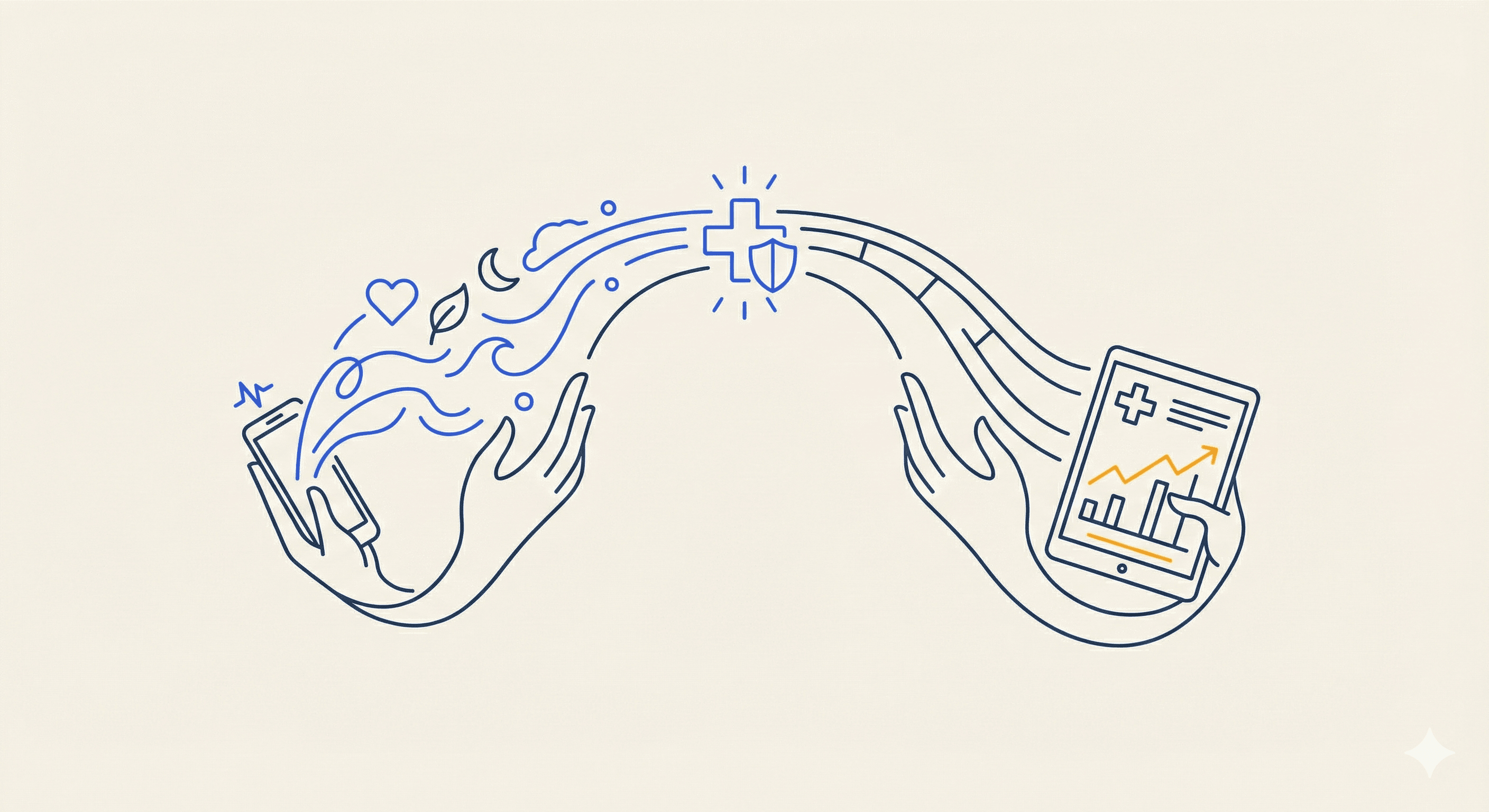
The main focus of healthcare today is wellness, and one vital component that must not be overlooked is data. Collecting that data is not, in fact, what is of the greatest value for companies. Handled responsibly (From how to store and secure users’ information in order not to violate rights), it can tell us how products should be made, what users want-and that is the basis for personalizing a consumer experience. Such evidence, in turn, might awaken each person who sees it (assuming they have been at all interested or focused on wellness from their own perspective). But with this opportunity also comes duties. Functions such as not only collecting and analysing wellness data, but also deciding what to track, how to store it responsibly, and acting on it in ways that respect users' trust as well as business value, remain. This playbook outlines the primary categories of wellness data, principles of responsible data stewardship, and strategic pathways to turning data into insights and outcomes--all without stepping over the boundaries of user privacy or ethical use. It is meant for any organization operating in the wellness, health tech, or lifestyle innovation sector.
By the time you finish reading this guide, you'll know:
Which categories of wellness data matter most
How to structure data collection for insight and compliance
How to transform raw information into meaningful, actionable intelligence
What is responsible data practice in 2025 and beyond
The New Face of Patient Support
Healthcare has followed a fixed rhythm for decades - a person noticed symptoms, made an appointment, saw a doctor, and then followed instructions. It worked best as a system for emergencies or certain issues, but left holes in everyday support. Although a patient might maintain between-treatment routines outside of the doctor's office, and keep up with exercises, at home, medicines breaking the habit, losing interest in repeating posture corrections across rooms just because they can be done uncomfortably, all these fine tasks require that powerful background of interfacing into orientation work. Statistics show that many are at a loss between sessions.
Wellness apps stepped into that space. They turned people’s daily habits into the care process itself. Sleep tracking, mood journaling, guided movement, mindful breathing: these were new tools for catching one’s health and holding it there.
Now those same tools are becoming part of a bigger picture. Clinics and hospitals are starting to incorporate wellness features into patient plans. Health care providers can use digital apps to encourage patients to perform exercises, monitor progress in recovery, or transmit educational content. When patients feel supported every day, they stay more consistent. That consistency helps make treatment effective.
CipherCross has seen this change first-hand. User-centric wellness design fosters trust and enables patients to feel guided rather than monitored. When apps focus on personal experience and gentle guidance, they become a true partner in health.
Why Integration Matters
Healthcare is complex. Doctors, nurses, insurers, and policymakers each play a role. The system is strong in clinical expertise, but often slow to adapt to user experience.
Apps bring a different strength. They know how to meet people where they are. They use design to motivate action. When integrated into healthcare, they can make complex plans easier to follow.
For example, after surgery, a patient may need to walk daily, track pain, and record recovery notes. An integrated wellness app can guide that process. It can show progress, send reminders, and share data with a care team. That creates a shared view of recovery without more appointments.
This integration supports both sides. Patients gain clarity and structure. Providers see more accurate updates. That makes care more responsive and reduces friction. The goal is not more data. The goal is more meaningful. When wellness data flows into clinical systems, doctors can spot trends sooner and adapt plans faster.
Integration also builds continuity. A doctor’s advice connects with a patient’s daily routine. A nurse’s follow-up connects with an app’s reminder. A care plan connects with digital feedback. The system starts to feel whole.
Building Trust Through Design
Trust is a key aspect of healthcare. For example, patients must believe that every piece of advice they receive is safe and given with a genuine concern for their welfare. This thinking is just equally applicable to health-related applications.
Transparency is the essence of trust. Attitudinally, users should know what kind of data is being collected, where it will be stored, who has access to this information, etc. They should have a sense of presence with respect to their data. Applications whose intentions and operational mechanisms are crystal clear establish stronger relations with their users. But design also plays a major part in the total impression. With a welcoming and peaceful surface, good design is necessary. Too complex a design, on the other hand, will make the onlooker feel stressed. In wellness support, good design goes beyond mere aesthetics and is part and parcel of the experience itself.
CipherCross builds products for wellness with this notion upfront and foremost. All features are designed with user compassion in mind: For example, if an application required users to breathe, stretch, or track their mood, then it should offer support rather than pressure. Thoughtful design elements--such as gentle language and user adjustability on reminders--show concern for users' lives.
When users feel valued and that they're respected, they're likely to use the app. Higher use brings better results. Again, it strengthens trust when apps comply with established medical guidelines. Wellness apps should reflect authentic clinical suggestions instead of following fads. Links to healthcare professionals reinforce this bond.
When transparency in interaction and information handling ethics converge, digital wellness tools become reliable allies in the delivery of care.
The Role of Personalization
For centuries, healthcare has sought to cure individual human beings. However, general categories still describe most treatment plans. So they really are average statistics, witnessing to nobody’s actual behavior. Personalising the user experience like wellness apps do is a direct way to bridge this gap. All responses are tailored to when moods, actions, and habits happen.
Personalisation does not necessarily equal complexity. It means relevance. A patient with stress in his life may seek one kind of help on a calm day and yet another when troubled; for him, the guidance is different. A user who is tracking his recovery after therapy might have reminders aimed at returning strength. These changes make guidance practical.
Personalisation is also a key to engaging users. When people see that an app understands what they are looking for, they trust it. Users log in more often. They feel listened to. Now, healthcare providers can make better plans according to this personalization. Instead of general advice, they help people take intelligent steps that match their needs and abilities. Or adapted to match lifestyle needs. The result is that care becomes more human, more humanized, and not some hollow computer response.
CipherCross often builds with this consideration in mind: personalisation has to be supportive, not threatening. Data is used to guide meetings, provide raw material, rather than condemning the truth behind other people's stories to condemn it. When successful, the outcome is that personalized wellness tools create an urgent rhythm. They help people stay near their goal without any sense of being controlled.
Hybrid Healthcare Models
Modern hybrid models of care are flexible and combine the best of both worlds. Physical visits still play a key role in patient-to-doctor communication, yet now digital tools have taken up the slack.
Wellness apps are integral parts of the care team. They remind people to take medicine. They 'feel' when a trend is not right and can bring feedback on that situation, complete with graphs as evidence. The doctor is still the medical expert. The app companion supports action for him.
This combines flexibility with virtual convenience. For patients who really need to be seen in person but do not wish a long journey, an appointment can be made in the general medical manager's clinic at any time of day or night, and some nurses are available around the clock. The phone is also used to keep track of current data from the therapist in traditional care, further blurring these lines between real life and electronic information flow.
This hybrid model also greatly extends accessibility. As some patients cannot easily get to a clinic, and clinical guide posts have been seen as worse than useless by the public (especially when they're staffed with snatch-and-grab artists!), remote tools can be used in guiding homes with clinicians doing the guiding from the hospital.
For health systems, then - and staff, this hybrid form of clinics can be both modern and efficient. Routine updates are done in a digital way. Complex requirements take up everything that manpower has left over to give them extra attention, and then a little more still, just for good measure! But no matter how various matters emerge from their place-holders on their own to occupy center-stage suddenly, when combined with real-life drag becomes a film(Classical style), the patient knows that he still has a good connection.
All that we were trying to do with this practice is to bring continuity in care across space. In clinics, diagnosis and treatment. Using apps, habits, and reflection. Both together encompass health in its entirety.
Data Sharing and Privacy
Every digital solution raises questions about data. Healthcare data is sensitive. It holds personal histories, conditions, and emotions.
To build integration, wellness apps must follow strong privacy standards. They must collect only what is needed and explain why. Users should always have the right to view, export, or delete their data.
Transparency is not just compliance. It is part of care. When people know their information is safe, they share more honestly. That honesty improves data quality and clinical insight. For integration to work, systems must connect securely. Data must move between apps and clinics in protected formats. Partnerships between developers and healthcare IT teams help achieve that.
CipherCross focuses on secure architecture from the first design stage. Scalable systems with clear access controls protect both users and providers.
Trust grows from clarity. When people see how their information supports their health, they see value, not risk.
The Human Element
Technology definitely has the potential to enhance care delivery, but the essence of care remains essentially human. Digital applications should always aim to support the interpersonal relationships in which we ourselves live and work, not replace human beings.
For instance, a well-being application may serve as a reminder for an individual to do some exercise, but it is the doctor who gives reasons why movement is important. Similarly, while an app could monitor emotions, it takes a therapist to lead the processing of these feelings. The human factor offers meaningful background, empathy, and connection.
For healthcare workers, digital tools help them to do more meaningful things in less time. By automating routine data collection, consultations can be devoted to gaining insights instead of dealing with paperwork. Patients come armed with information that truly represents their lives.
This partnership raises outcomes for both parties involved. The application encourages patients to be proactive about their health, while health workers will give indispensable guidance on that data.
Hybrid care models are most effective when guided by humanity. Technology should be a supporting rather than a hindering resource.
Barriers to Integration
No matter how, there are also cultural barriers to overcome: some doctors worry that the spread of technology will interfere with patient care and overwhelm them, while other patients are afraid of digital tools.
A combined effort and time are needed to tackle these problems. In both cases, education helps. It can help to make clear the benefits and dangers of new technology or traditional clinical methods, and show how both sides might benefit from one another's strengths and limitations. Co-design sessions with patients, providers are critical.
CipherCross has discovered that when there are partnerships, progress grows. When developers, clinicians, and other health service professionals share the same goal, integration becomes a simpler job.
The first step in integration is to agree on the language being used. Healthcare speak is outcomes. Technology speak is engagement. Both succeed. Connecting them so that one supports the other creates real value.
The Future of Digital Integration
Integration will intensify as technology advances. Even an artificial intelligence computer could pick up early patterns of changes in health data. Predictive analytics will give generalized guidance. Wearables and whatever clinical dashboards they're connected to are closely integrated.
And yet innovation must have roots. Tools should serve people, not the other way around. Healthy lifestyle apps need to be flexible, open, and human.
Excellence combined with compassion. We envision a future where physicians remain decision makers. An app is where a friend can always be found. Patients must become active participants.
This shared environment will not substitute traditional medicine. It will bring out the best in it.
How CipherCross Supports Integration
CipherCross builds wellness apps designed for collaboration. Every project begins with a focus on the user. Every system scales with healthcare needs. Every workflow respects data privacy and patient dignity.
The company’s experience in wellness architecture helps bridge clinical and digital systems. CipherCross understands how to design apps that feel natural for users and useful for providers.
From concept to launch, each solution aligns with human care values. The goal is not more features. It is a better connection.
If you plan to integrate wellness support into your healthcare service, start with clarity. Define who it helps, how it fits, and what outcomes it should improve, then build with empathy.
Dive into our diverse articles – from wellness app design and AI personalization to software development best practices, operational workflows, and strategic guidance.



Load More